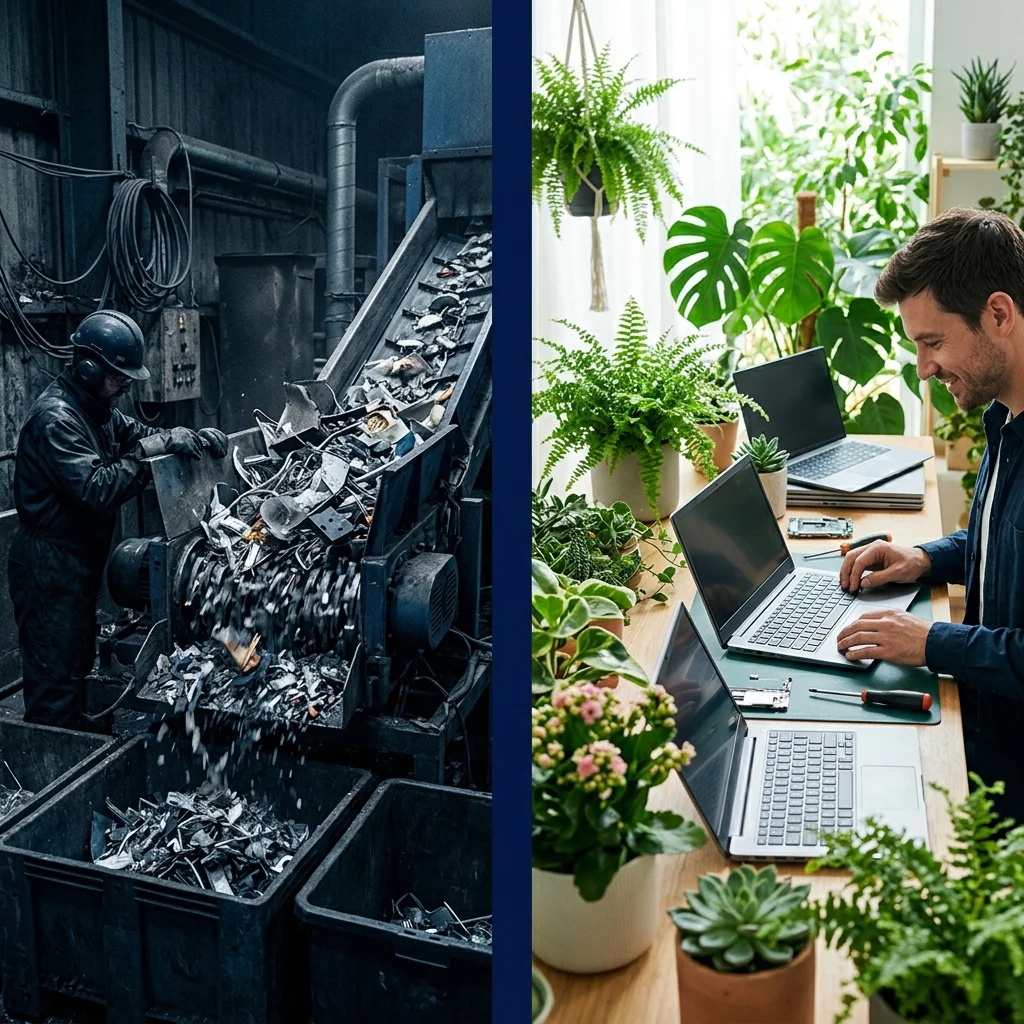
Sustainable Computer Equipment: a 2026 guide for Mexican companies
How to make your IT fleet greener: carbon footprint, purchasing criteria, life extension, end-of-cycle circularity and compliance with Mexico's General Law on Circular Economy (LGEC). For CIOs, sustainability officers and procurement.
Published May 17, 2026 · By Ezequiel Osuna, Sustainability and Regulatory Expert · 13 min read
What is sustainability in computer equipment?
Sustainability in computer equipment —also called sustainable IT hardware— is the set of practices that reduce the environmental impact of laptops, desktops, servers, monitors and peripherals across their entire life cycle. It is not just "buying green": it is a comprehensive strategy that covers purchase, use, maintenance, reassignment and final disposition.
Investors and corporate customers increasingly evaluate their suppliers on environmental criteria.
The hidden costs of maintaining inefficient IT fleets are significant.
The real carbon footprint of an IT fleet
To weigh IT sustainability decisions properly, you first need to know the impact figures. These are typical references for enterprise hardware:
Equipment
Manufacturing footprint (Scope 3)
Annual consumption (use)
Corporate laptop
200-400 kgCO2e
~30 kgCO2e
Desktop + monitor
400-700 kgCO2e
~120 kgCO2e
1U server
1,500-3,000 kgCO2e
~1,500 kgCO2e
Enterprise switch
300-600 kgCO2e
~200 kgCO2e
Business smartphone
60-90 kgCO2e
~5 kgCO2e
The key insight: manufacturing dominates the footprint in laptops and smartphones. For servers, operation matches or exceeds it. That is why sustainable strategies differ by asset type: extend useful life for client devices, optimize consumption for infrastructure.
Sustainable purchasing: criteria for new equipment
When a purchase is unavoidable, these are the criteria every company should build into its tender specifications:
EPEAT Gold or higher: a global certification of the environmental impact of electronic equipment.
ENERGY STAR: energy efficiency in operation.
iFixit repairability score ≥ 7/10: ease of repair and component replacement.
Spare parts availability from the manufacturer for at least 7 years.
% of recycled material in the manufacture of the equipment (leading manufacturers declare 25-50%).
Packaging free of single-use plastics.
Public manufacturer commitments to net-zero by 2030/2040.
Including these criteria in your supplier evaluation matrices turns sustainability from an aspiration into a contractual specification.
Life extension: the most cost-effective lever
Each additional year you keep a device in productive use reduces the attributable carbon footprint almost linearly. A laptop used for 6 years has half the annual impact of one used for 3.
Life-extension actions:
RAM upgrade: adding RAM extends a laptop's productive life by 1-2 years at minimal cost (~$1,500 MXN vs. $25,000 MXN for a new device).
Replacing the HDD with an SSD: revives 4-6-year-old equipment with a drastic performance improvement.
Battery replacement: extends laptops by an additional 2-3 years (~$1,200 MXN).
Periodic deep cleaning: prevents thermal failures.
Reassignment to secondary roles: equipment retired from development can serve 2-3 more years in administration.
Refurbished equipment: the sustainable shortcut
Buying refurbished instead of new avoids 80-90% of the manufacturing footprint —the big avoided impact— while maintaining performance equivalent to 95% of the original.
Administrative roles where the latest generation is not required
Contingency and backup equipment
Training and test environments
Temporary headcount expansion (projects)
Donations to internal or external programs
Professional refurbishment includes: hardware diagnostics, replacement of worn components, certified NIST 800-88 data erasure, a clean OS reinstall, quality certification and a commercial warranty.
End of life: circularity and LGEC compliance
At the end of primary life, the question is not "where do we throw it away?" but "how do we extract the maximum remaining value?" The answer is a professional ITAD technology circularity program that applies the hierarchy:
Reuse: assess whether it can have a second life in another organization (remarketing) or through structured donation.
Refurbish: intervene technically to extend useful life.
Recycle: the last resort. Certified disassembly and material recovery.
The program must comply with: the LGEC (traceability) and LFPDPPP, Mexico's federal data protection law (certified data erasure), and produce verifiable metrics (kg of CO2 avoided, value recovered, materials reincorporated).
A 30-day plan to get started
If your organization does not yet have a formal sustainability strategy for computer equipment, this plan speeds up the start:
Week 1: Baseline
Inventory of equipment in use, in storage and obsolete
Approximate calculation of Scope 3 hardware (use typical references if no specific data is available)
Identification of current disposal and storage costs
Disposition of an initial lot (50-100 stored devices)
Receipt of individual certificates and impact report
Presentation of the baseline and plan to the executive committee
Frequently asked questions
What is sustainability in computer equipment?
Practices that reduce the environmental impact of laptops, desktops, servers and peripherals across their entire life cycle: purchase, use, maintenance, reassignment and final disposition.
How do I make my IT fleet more sustainable?
(1) Buy EPEAT/ENERGY STAR equipment; (2) Extend useful life with upgrades; (3) Automatic shutdown; (4) Reassignment to secondary roles; (5) Professional ITAD at end of life.
How large is a laptop's carbon footprint?
Approximately 200-400 kgCO2e in manufacturing + 30 kgCO2e per year of use. That is why extending useful life is the lever with the greatest environmental impact.
Are refurbished laptops sustainable?
Yes. They save 80-90% of the footprint vs. buying new, while maintaining 95%+ of the performance. One of the most impactful and cost-effective actions.
Calculate the footprint of your current fleet
In under 72 hours we estimate the recoverable value, avoided risk and kg of CO2 you can avoid with a sustainability program for computer equipment.